

Free Speech Centre Hosts Annual Conference on World Press Freedom Day, Spotlighting Global Threats to Journalism
On May 5th, 2025, the Free Speech Centre hosted a conference to mark World Press Freedom Day. The conference aimed to respond to escalating threats against media freedom worldwide, while portions of the event focused specifically on the dire conditions of media freedom, and the threats journalists face specifically in Afghanistan. The event emphasised how the Taliban have criminalized core aspects of journalistic work, while at the same time highlighting that freedom of the press is under pressure globally to an extent not seen in decades, if not over the past century. The event took place at Innis College, University of Toronto, bringing together over 200 journalists, international media advocates, academics, and students from the University of Toronto, George Brown College, and Seneca College. Also in attendance were leaders of Canadian media-support organizations and a significant number of Afghan journalists now living in exile.
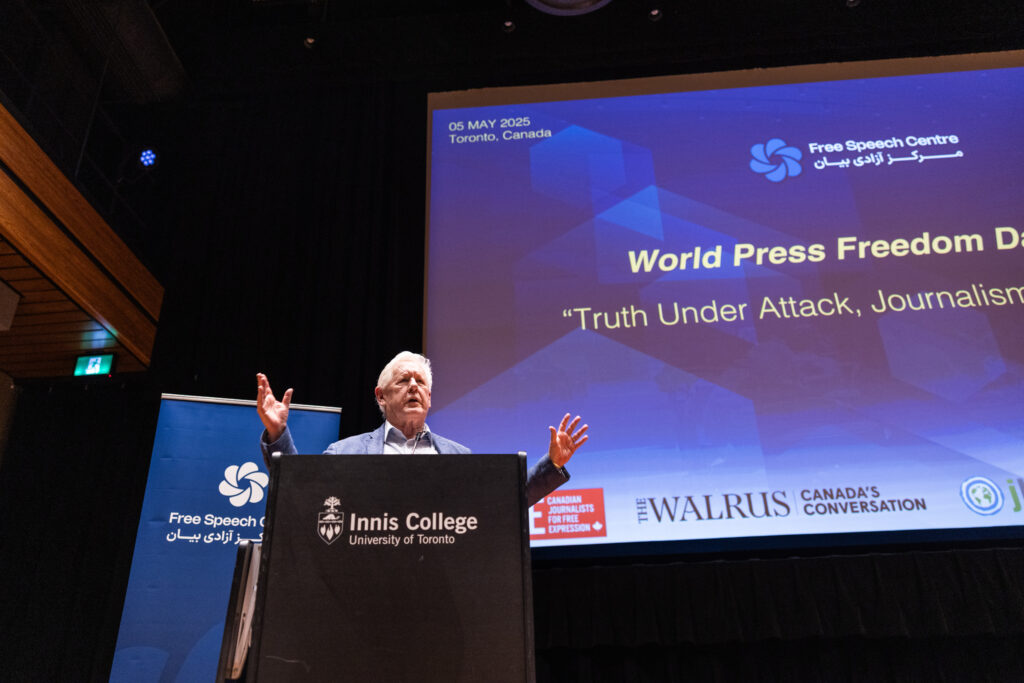
The conference opened with a moving speech by Bob Rae, Ambassador and Permanent Representative of Canada to the United Nations, which also clearly expressed Mr. Rae’s concern about the state of journalistic freedom worldwide and the situation in Afghanistan, specifically. He also discussed the human rights situation in Afghanistan more generally, stating “we’re living in a situation of modern apartheid – of a gender apartheid.” Mr. Rae’s speech was positively received by the entire audience, who saw him speaking truth to a very difficult problem that must be addressed worldwide. Mr. Rae summed up the threat facing journalism with his statement and his call to action: “The world is facing a major threat, and the media in many countries are being systematically targeted. The international community must unite and stand in solidarity to defend these fundamental values.” But Mr. Rae also focused on something more integral to the journalists’ craft – that of truth telling, even in the fact of adversity – and the importance this holds in Canada, a country that has welcomed people seeking refuge from all over the world. “Freedom matters….but we also understand that without journalists, without the media, without the press….it would be like not having the air we need to breathe. In order to breathe we must know the truth.” Mr. Rae further stated “since the last 50 years we have been a place where people can come……and we are in this struggle together. We defy those people who say people are too far away, we defy all those people who say truth doesn’t matter.” This was an important theme of the night. Canada holds a particular place in the world right now, defending democratic and humanistic values that are being forgotten or forsaken elsewhere. And Canada’s support for journalists is one aspect of its dedication to these values.
The conference featured two panel discussions focused on the state of press freedom and free expression in Afghanistan, the restrictions imposed by the Taliban on journalists, and the global outlook for freedom of expression. Journalists and media support organization representatives explored opportunities to defend press freedom both in Afghanistan and worldwide, and presented strategies to strengthen the global flow of information and protect the journalists who make this possible.
The first panel, titled “Truth in Hostile Times: Journalists in Repressive and Democratic Societies,” was hosted by Lotfullah Najafizada, Director of Amu TV. Mr. Najafizada is familiar to anyone who spent time in Afghanistan prior to the Taliban takeover of the country – he was one of the premier interviewers and journalists before August 2021 in Afghanistan.
It featured panelists Jennifer Hollett, Executive Director of The Walrus; Michelle Shephard, journalist, filmmaker, and Co-President of CJFE; Brent Jolly, President of Canadian Association of Journalists (CAJ); and Lucan Way, Professor of Democracy at department of political science at the University of Toronto. The panel examined the challenges journalists face in both authoritarian and democratic contexts.
While the panel was not focused on any specific country and the discussion ranged on topics related to the entire world, panelists discussed recent tensions in the United States following President Trump’s term in office, focusing on how media and freedom of expression have come under pressure. They shared global perspectives and analyzed the threats from multiple angles. This panels alarm at developments south of the Canadian border should be taken very seriously. Journalists need to be protected all around the world, in places far from Canada. And yet, journalists in the United States are suffering a chilling effect based on their government’s action, and Canadian journalists in the panel expressed that they no longer view the United States as an entity that is friendly to foreign journalists.
The second panel, titled “From Headlines to Silence: The Fight for Journalism in Afghanistan,” addressed the current state of freedom of expression in Afghanistan. It featured Shoaib Rahim, university professor; Farida Nikzad, researcher at Carleton University; Zahra Nader, founder of Zan Times; and Bilal Sarwary, who reported on Afghanistan for over a decade for BBC World News. The panel was moderated by Samia Madwar, Senior Editor at The Walrus. It highlighted the efforts of Afghan journalists to preserve their work despite severe restrictions and threats. All of the journalists who spoke at this panel were extremely important in Afghanistan in reporting the difficult situation there – and they continue to work in journalism to bring attention to the issues of Afghans and Afghans abroad.
During the event, Najib Asil also announced a new initiative titled “Documenting Your Time Through the Eyes of Journalists.” He invited hundreds of Afghan journalists to write stories from their personal exprerince of the past two decades of change— their struggles, and hopes for the future.
At the conference, Rachel Pulfer, Executive Director of Journalists for Human Rights (JHR), was honored for her organization’s critical role in supporting and relocating Afghan journalists and activists since 2021. According to Pulfer, 2,400 Afghan journalists and human rights defenders have been relocated to Canada so far.
The event also honored Rubaba Mohammadi, an Afghan artist, in celebration of World Press Freedom Day. She was recognized for her courage in expressing herself through mouth painting despite her physical disability, and for her ongoing advocacy for women’s rights in Afghanistan.
Additionally, several representatives from international organizations supporting journalism and free expression shared video messages reflecting on the status of press freedom in Afghanistan and around the world. They included UN Special Rapporteur for Human Rights in Afghanistan Richard Bennett, Afghanistan Permanent Ambassador to the UN Nasir Ahmad Andisha, and academic Michael Semple.
Alongside other Afghan and international media advocates, Najib Asil called on the Government of Canada and media-support organizations to enhance their support for Afghan journalists. He specifically requested assistance with employment and resettlement for those facing severe hardship in Pakistan, Iran, and Turkey.
The Free Speech Centre expressed deep concern over the deteriorating media situation in Afghanistan, where journalists face economic hardship, security risks, and mental health challenges — both inside the country and in neighboring states. As the Taliban continue to impose restrictions, including expanding bans on publishing images of living beings in more than half of Afghanistan’s provinces, the future of journalism in the country remains dire.
Najib Asil, founder and executive director of the Free Speech Centre, stated in his opening remarks, “124 journalists lost their lives in 18 countries in 2024 — it was the deadliest year for journalists worldwide.” A moment of silence, which extended for much more than just a moment, highlighted this tragedy as the names of journalists lost over the past year were displayed on the screen. All audience members bowed their heads in silence and reflected upon the importance journalists bring to free societies, and the implications that so many loses have – both to journalism as a profession and to those who were killed while undertaking such very, very important work. Several audience members had tears streaming down their faces, and audible sighs of pain were heard throughout the auditorium as the many journalists in attendance remembered and honored the loss of their colleagues.